Demand and price
Every shop has a price slider from 0.7× to 1.5×. Shoppers pick a shop by distance, appeal and queue, and the price decides how many of them buy. Once a queue passes 7 people, others stop coming (patience is 40 seconds). So: long queue, raise the price; empty queue, lower it. Daily trends (a hot day doubles ice cream) shift the demand curve.
Fixed and variable costs
| Cost | How much | When |
|---|---|---|
| Salaries | 4,000–10,000 som/min per worker | every 30 s (even with no sales) |
| Rent | 0.6 % of plot price / min | second and later shops |
| Tax | 5 % (village) / 12 % (city) of income; accountant ×0.6 | every 2 minutes |
| Equipment and plots | one-off; each next unit costs more (plots +22 %) | when bought |
| Theft | 60 % of the cash pile, up to 800k | owner away, no guard, pile ≥ 40k |
Salaries and rent are fixed costs: they go out even with no sales. Tax is variable: it depends on income. So a shop with 3 workers must sell at least 18k a minute or it loses money.
The economics of location
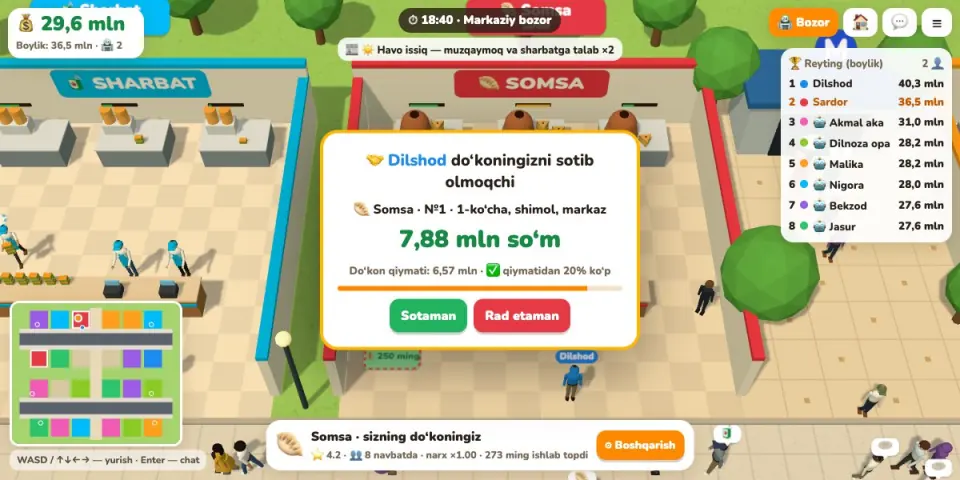
A village plot costs 250k–1.5M with 5 % tax but little traffic. A city plot costs 10–40M with 12 % tax and roughly 3× the traffic. Do the maths: a 20M plot pays 120k rent a minute plus 12 % tax, so it must sell at least 200k more than a village shop to pay off. A ⭐⭐⭐⭐⭐ plot by the metro does that; a ⭐⭐ plot on the edge does not.
For pupils and students
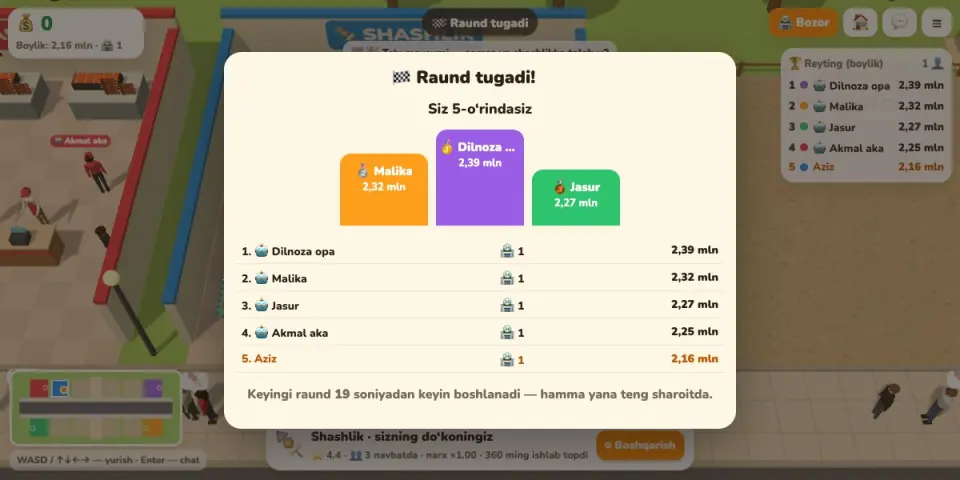
Concepts the game shows: supply and demand, price elasticity, fixed and variable costs, break-even, location rent, tax rates, reinvestment, risk (thieves) and insurance (a guard). A teacher can create a closed room and discuss the results table after a 10-minute round.
How to start
- Press “Play” and type a name: no sign-up, password or download.
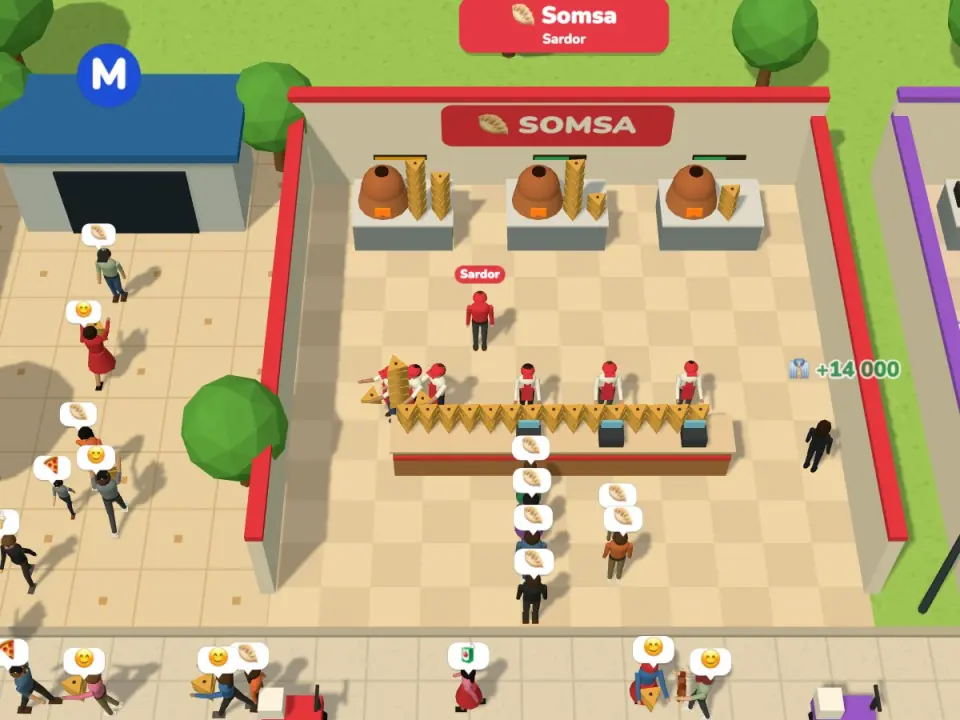
- Your first shop is free (the cheapest empty plot in the village). Pick a product; flatbread is the easiest start.
- Sell yourself first: carry goods from the station to the counter and stand at the register. Once cash builds up, hire a cashier and a carrier.
FAQ
Does this game teach economics?
It shows the basics in practice: costs vs income, price vs demand, location vs rent. It does not replace a textbook, but in 10 minutes it answers “why did I lose money”.
When and on what is tax charged?
Every 2 minutes, on that period’s income: 5 % in the village, 12 % in the city. An accountant (1.5M) cuts tax by 40 %.
Is rent paid on every shop?
The first shop is rent-free. The second and later ones pay 0.6 % of the plot price per minute, taken from the owner’s cash every 30 seconds.
See also
 Business game — all topics12 pages
 Business game on your phone — no downloadAndroid, iPhone, touch controlsEntrepreneurship game — business simulatordecisions, zero capital, lesson formatNational cuisine game — open a teahouseplov, manti, lagman + tea: a teahouse
 Savdo Shahri guiderules, economy, tips