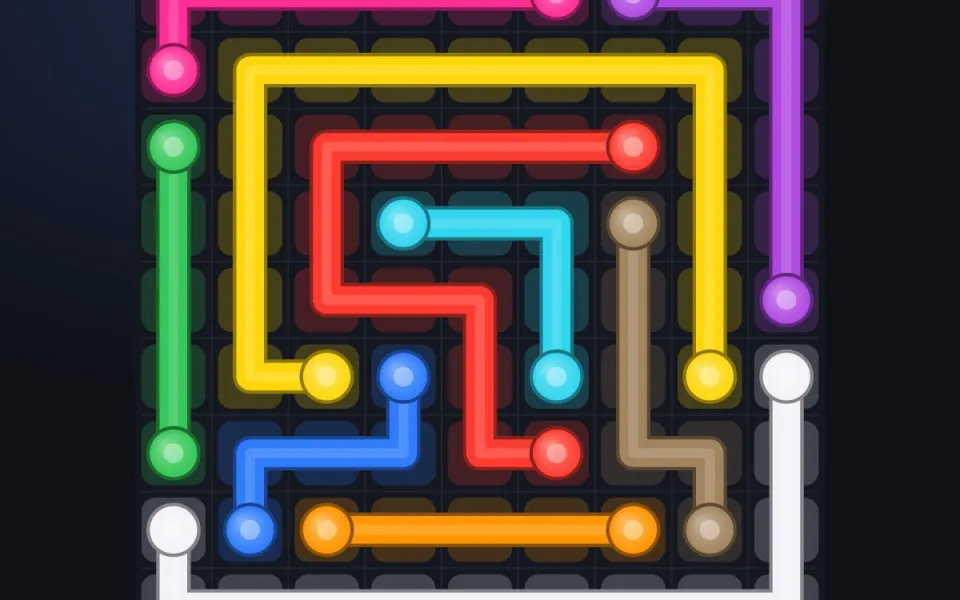
1. Walk the edges first
Cells on the border of the board have only two or three neighbours, so very few lines can reach them. Look at each edge and ask which color can possibly cover it. Often a dot sitting right on the edge must run along that edge, because nothing else can get there. Edge lines are the safest first moves and they shrink the rest of the puzzle.
2. Corners are forced
A corner cell has exactly two neighbours. Whatever line enters the corner must leave through the other neighbour, unless a dot sits in the corner itself. So a corner with a dot in it starts a line in one of two directions, and an empty corner is a tunnel: the line that fills it goes in one side and out the other. Decide the corners before the middle.
3. Pairs of dots next to each other are a trap
Two dots of one color that are close together look like a one-cell line, but the level generator never leaves a pocket of empty cells that nobody can reach. If the short link would strand cells against the border, that line has to take the long way around and come back. Ask: “if I link these the short way, who fills the cells behind them?”
4. Count cells, not colors
The board must be covered completely. Before drawing the last few lines, count the empty cells in each region and check that the lines passing through can really cover them one by one. A region with an odd leftover cell usually means a line has to wiggle through it rather than cut straight across.
5. Long lines take the detours
Every level has one or two colors whose dots are far apart. These long lines are the flexible ones: they can snake through the leftover space, while short lines near their dots have no slack. Draw the short, forced lines first and leave the long “filler” color for last.
6. Draw forced lines first, then undo instead of guessing
If two routes look possible, draw the one that keeps more options open for the other colors. When it fails, ↶ Undo is free and keeps your star rating; a hint is not. Three stars require one move per color, so plan the whole board, then draw. Restart (↻) when the layout is clearly wrong: redrawing from scratch is faster than untangling.
7. Use the fill percentage
The “Filled” counter above the board tells you how much of the grid is covered. When all pairs are linked but the counter is below 100 %, some line took a shortcut. Look for an empty pocket and find which neighbouring line can bend into it; that is always the fix.
FAQ
Why can’t I finish when every pair is connected?
Because some cells are still empty. Dot Link requires the whole board to be filled; find the empty pocket and reroute the nearest line through it.
Does the game ever have more than one solution?
Sometimes, especially on big boards. Any layout that links every pair and fills every cell counts as solved, so you do not have to find the exact built-in solution.
How do I get three stars?
Plan first, then draw each line once without using hints. Undo does not cost stars, but every extra drag counts as a move.
Is there a time limit?
No. The time you took is shown after solving, but it never affects stars.
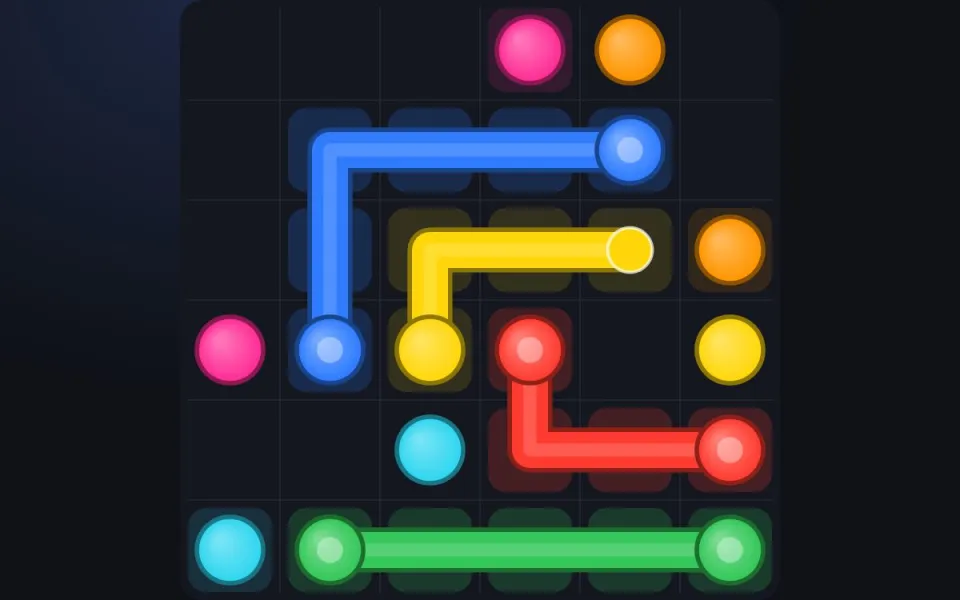 How to play Dot Linkrules, controls, stars
 Hard levels10×10 to 14×14, 16 colors
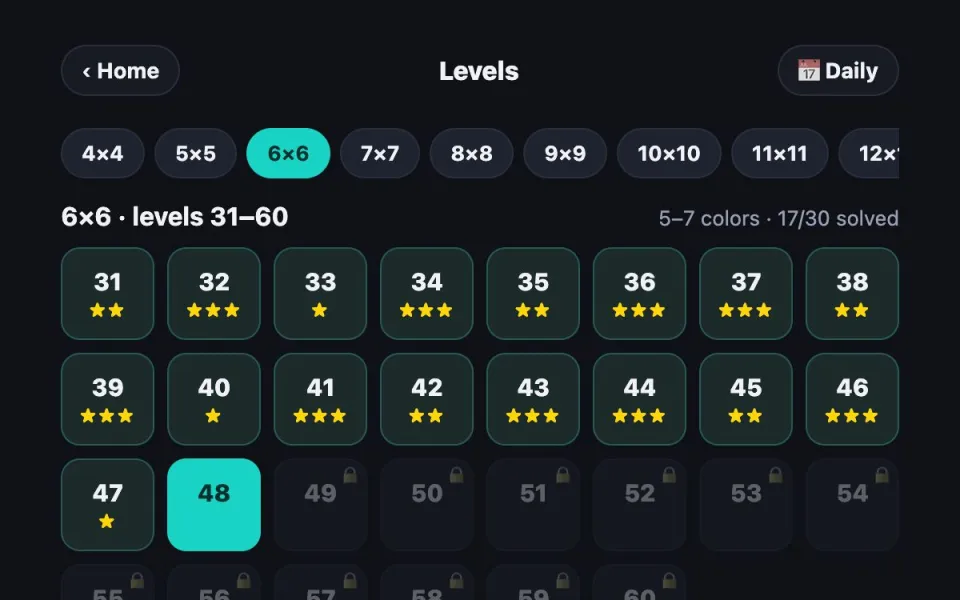 Levels & difficulty4×4 to 14×14 and endless
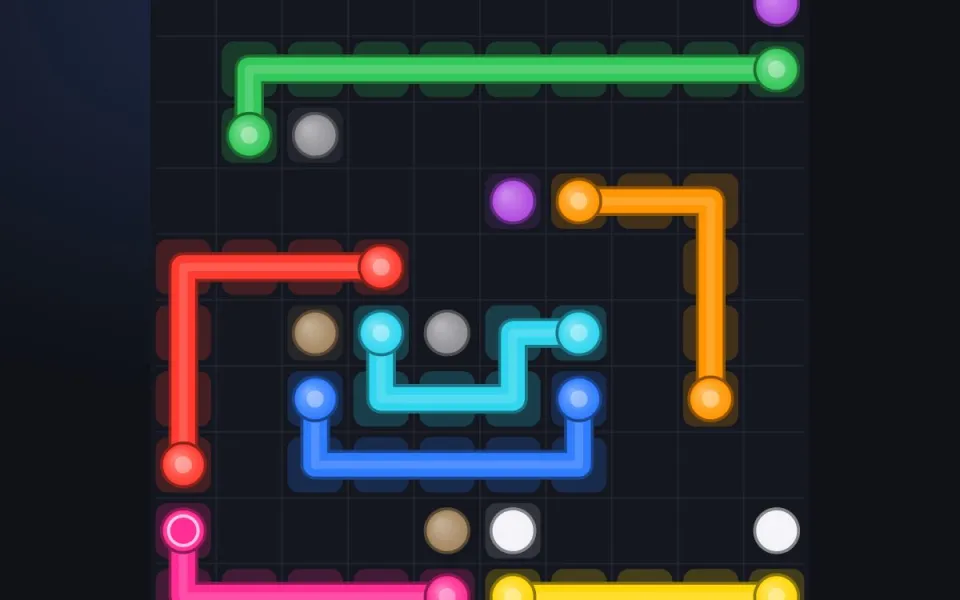 Brain trainingfocus, planning, patience