1. Read every word before you tap
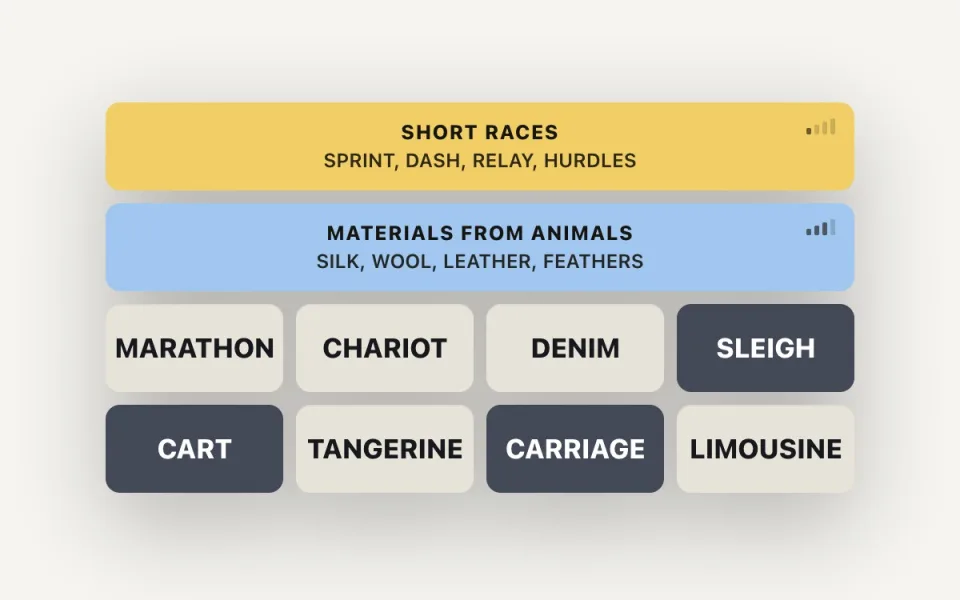
The first set that jumps out is often the trap. Read all 16 words and ask of each one: “where else could this go?” Note the words with two meanings; those are usually the decoys.
2. Look for the fifth candidate
If five words fit a theme, one of them belongs elsewhere. Work out which of the five could also fit somewhere else, set it aside and submit the other four. This habit prevents most mistakes.
3. Start with the most specific group
A broad theme (animals) pulls in many words; a narrow one (sea animals only) pulls in few. Solve the narrow group first: the board shrinks and the remaining links show more clearly.
4. Read the “Close” hint carefully
“Close” means three of the four are right, but not which three. Before swapping a word, think: which one could also fit another group? Swapping at random burns through mistakes fast.
5. Leave the wordplay for last
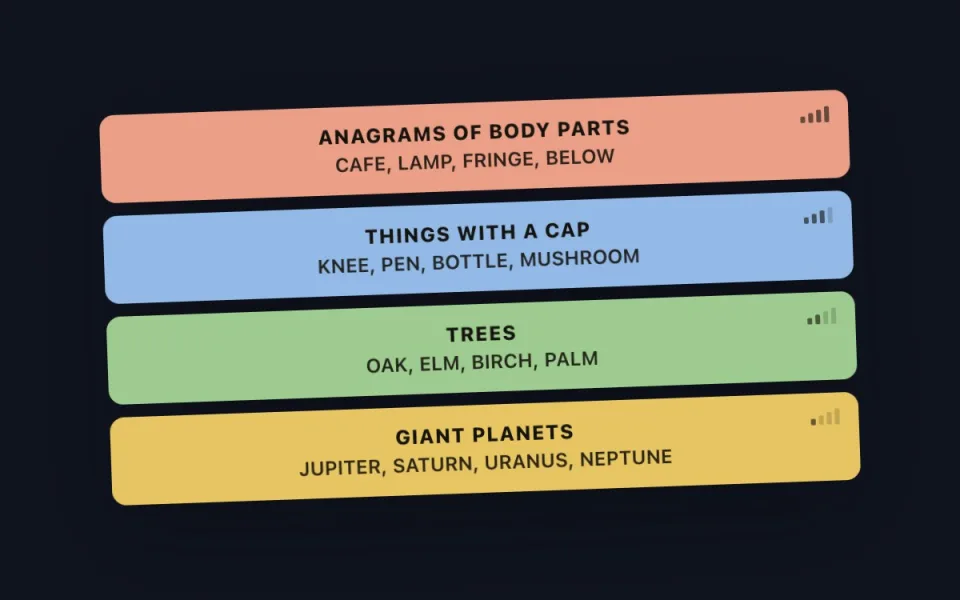
The trickiest (coral) group is usually wordplay: a hidden word, a “___ + word” pattern or a homophone. Once the meaning-based groups are out, look at the leftovers for a link in form: beginnings, endings, a word inside a word. More in the kinds of groups guide.
6. Use Shuffle
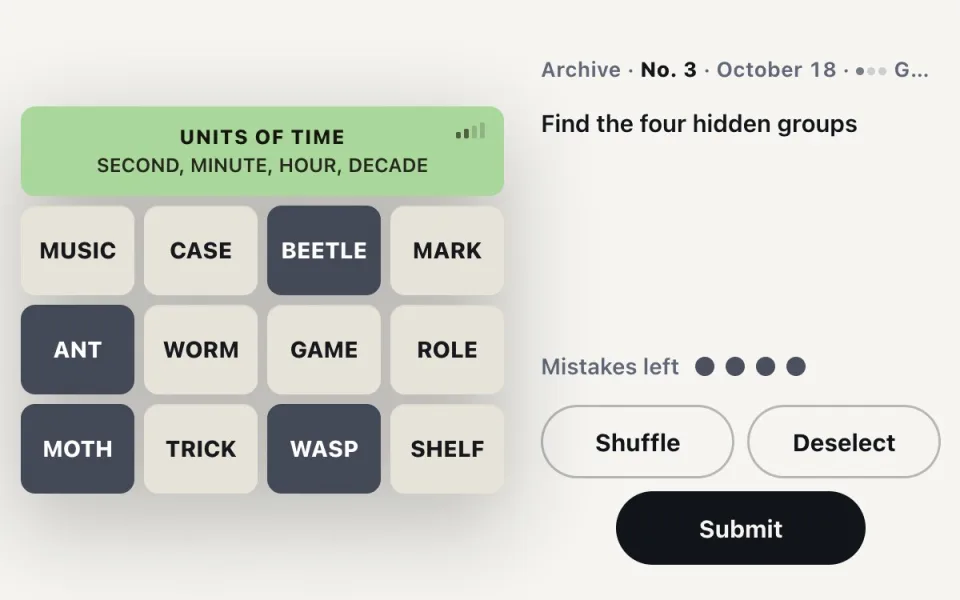
Your eye gets used to one layout, and neighbouring words start to look like a group. Shuffle moves everything to new spots and often reveals a new link. It never costs a mistake.
7. Name the group before you submit
Can you name the group precisely before submitting? “These are cities” is not enough; it has to be “capitals” or “cities on the Danube”. If no precise name comes, the four is probably accidental and one word is out of place.
8. A mistake is information too
If a wrong guess does not show “Close”, at most two of those four share a group. Treat them as two pairs and look for each pair’s partners. If “Close” appears, three are right, and the odd one is usually the word you hesitated over.
FAQ
Is guessing worth it?
Only at the end. Early on, even one mistake makes later choices harder.
Which colour is the hardest?
Coral, level 4: usually wordplay. Yellow, level 1, is the easiest.
How can I practise?
Play past puzzles from the archive; they do not affect your streak.
 How to play Quartetsgroups, colours, mistakes
 Kinds of groupsknowledge, shared trait, wordplay
 Daily puzzleone for everyone, streaks, archive
 Word association game onlinefree, no sign-up