The core idea: compare two numbers
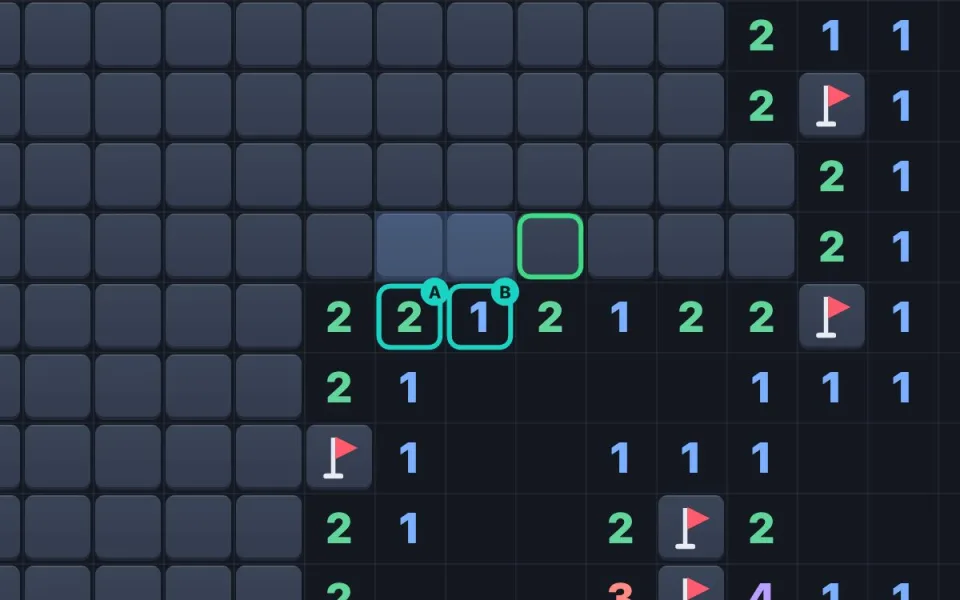
Let A and B be neighbouring numbers. Some of their closed cells are shared. Work out how many of A’s mines must be in the shared cells, and you can conclude something about B’s other cells: either all safe or all mines. The in-game hint explains it exactly this way, with A and B labels.
1-1
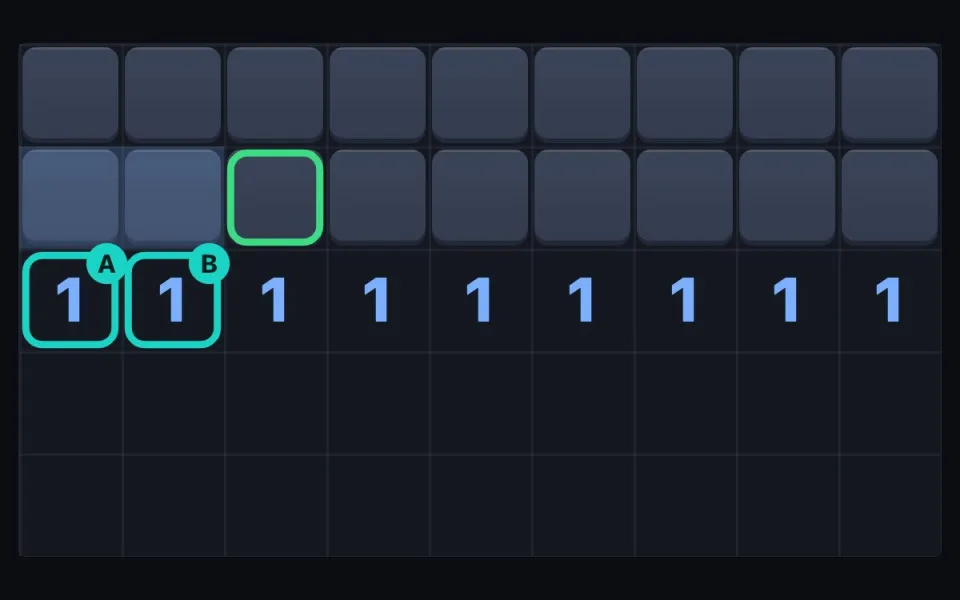
Two 1s stand side by side at the start of a wall. A has two closed cells, and both also touch B. A’s single mine is in those two cells, so that is also B’s mine. So B’s third closed cell (green) is safe.
1-2
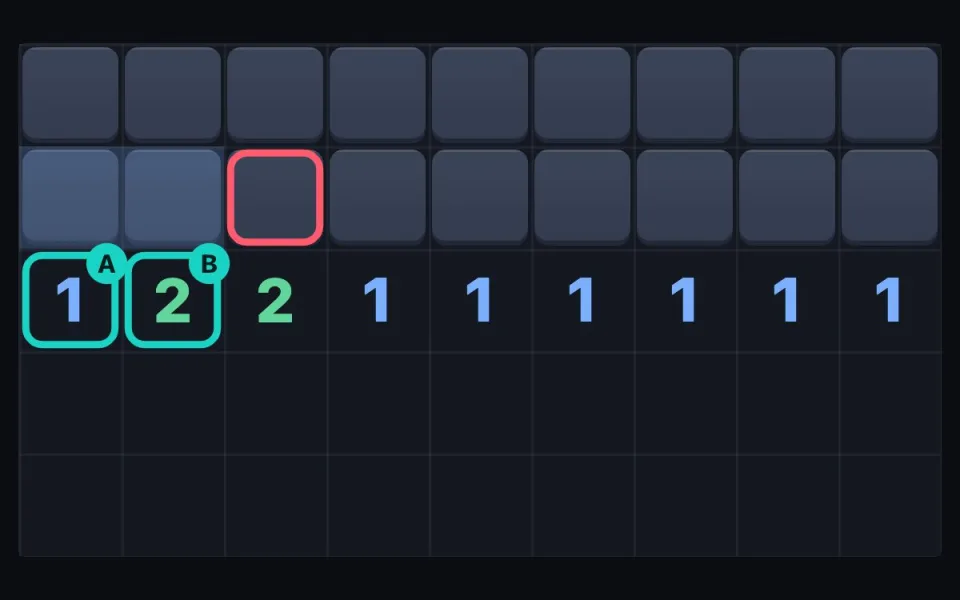
A = 1, B = 2. The shared cells can hold at most one mine, because A only needs one. B needs two, so the second is in B’s only cell that does not touch A. That cell (red) is a mine.
1-2-1
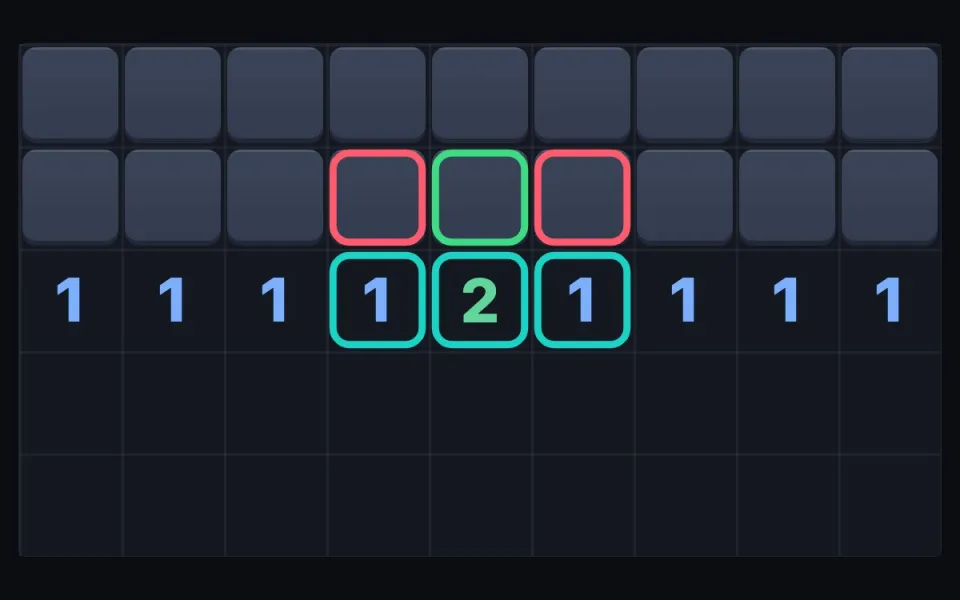
A wall shows 1, 2, 1 in a row. Apply the 1-2 rule from both sides: the left 1 and the 2 put a mine above the right 1, and the right 1 and the 2 put a mine above the left 1. The 2 is now full, so the cell above it is safe. The result is always the same: mines above the 1s, nothing above the 2.
Other cases and the mine count
Sometimes two numbers are not enough: you need to look at three or four together, or use the total mine count. For example, if the counter shows 0 at the end, all remaining closed cells are safe. Boards in No guessing mode are solved by logic within small groups. About No guessing mode.
FAQ
How do I learn patterns quickly?
Play Beginner and press Hint when stuck: it shows which numbers to look at and explains the proof. Games with hints are not ranked, but they are ideal for practice.
Do these patterns work when the wall turns?
The core idea does: compare the closed cells of two numbers. Count which cells are shared rather than relying on the shape alone.
 Minesweeper online: free and luck-freethree levels, phone and desktop
 Minesweeper rulesnumbers, flags, chording
 No guess Minesweeper: logic instead of luckwhat is guaranteed, honestly
 Daily Minesweeper: today’s board is the same for everyonea new shared board every day