What the simulation showed
Each row: games on a 4×4 board played that way, and the share of them that reached each tile.
| Who played | Games | 256 | 512 | 1024 | 2048 | 4096 | Avg score |
|---|---|---|---|---|---|---|---|
| Random moves | 20 000 | 8.3% | 0.01% | 0% | 0% | 0% | 1 107 |
| Corner rule (no thinking ahead) | 20 000 | 50.9% | 4.63% | 0.01% | 0% | 0% | 2 546 |
| Corner + looking 2 moves ahead (bot) | 400 | 99.3% | 96.8% | 90.8% | 62% | 5.75% | 25 473 |
| Corner + looking 3 moves ahead (bot) | 200 | 100% | 100% | 99% | 86.5% | 20% | 35 296 |
- Random moves never reached 2048 in 20 000 games: the best was 512, in just 0.01%. A game ends after 119 moves on average.
- The corner rule (down, left; otherwise right; up only as a last resort) scores more than twice as much as random, yet it never reached 2048 either: 1024 in only 0.01% of games.
- Corner + lookahead. A bot that keeps the same corner but looks just 2 moves ahead reached 2048 in 62% of games, 3 moves ahead in 86.5%, and even 4096 in 20%.
The takeaway: pressing the same keys in rotation does not work. The gain comes not from the corner itself but from thinking a step or two ahead before each move.
The corner method, step by step
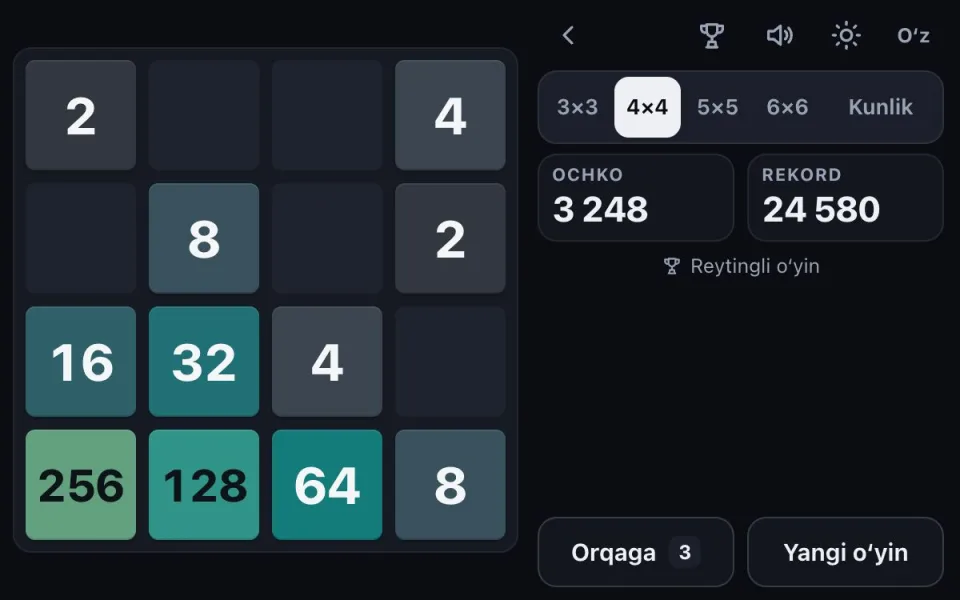
- Pick one corner. Your biggest tile lives there. With the bottom-left corner, your main moves are down and left.
- Keep the corner’s row full. With a full row, the biggest tile stays put even when you move right, which makes that move safe.
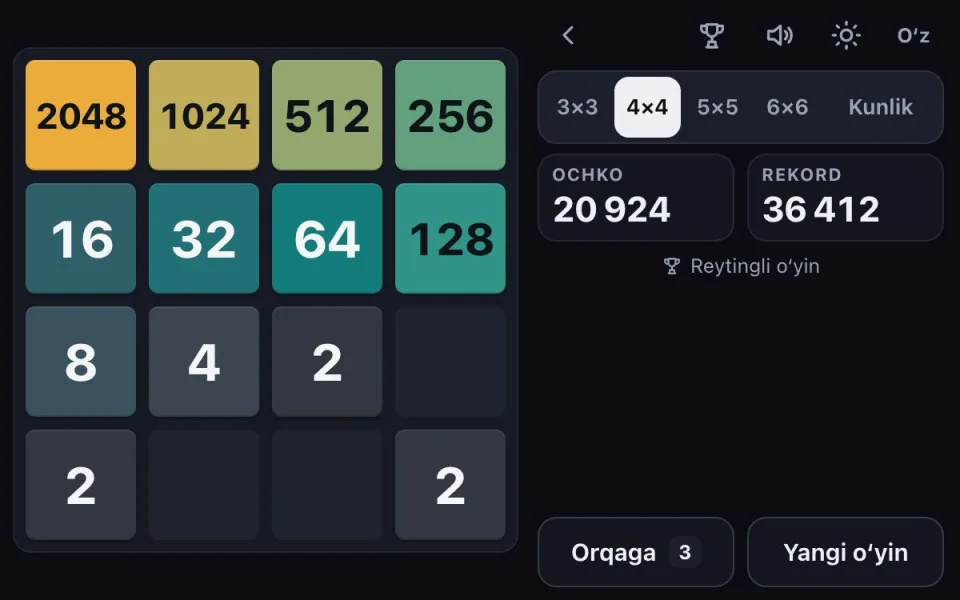
- Build a snake. Largest to smallest along the first row, then back the other way on the next: say 2048, 1024, 512, 256, then 16, 32, 64, 128 below. A single merge then collapses the whole chain.
- Avoid the forbidden direction. A move away from the corner (up, for bottom-left) only when nothing else is possible. If forced, go straight back: a 2 landing in your corner is the biggest danger.
- Ask a question before every move. “Where can the new tile land after this move, and would it break my chain?” That is exactly what the bot in the simulation does, and it will serve you too.
- Build small tiles next to the chain. A small tile left far away takes up space and chokes the game.
Where the numbers come from
Calculated by a small bot on the same code as the game (identical rules and new-tile odds). It scores the board with snake weights and picks the best move given where a new tile might land (expectimax). It is not a strong program, which is the point: it shows what happens when a person thinks two or three moves ahead.
FAQ
What is the simplest way to win at 2048?
Keep your biggest tile in one corner, keep that row full, and think about where the new tile will land before you move. Pressing keys in turn is not enough: that rule never reached 2048 in the simulation.
Does the corner method always win?
No, new tiles are random. Even the bot looking 3 moves ahead missed 2048 in 13.5% of games.
Which corner is best?
It makes no difference, the board is symmetrical. On a phone many people prefer a bottom corner, since the thumb naturally moves down and sideways.
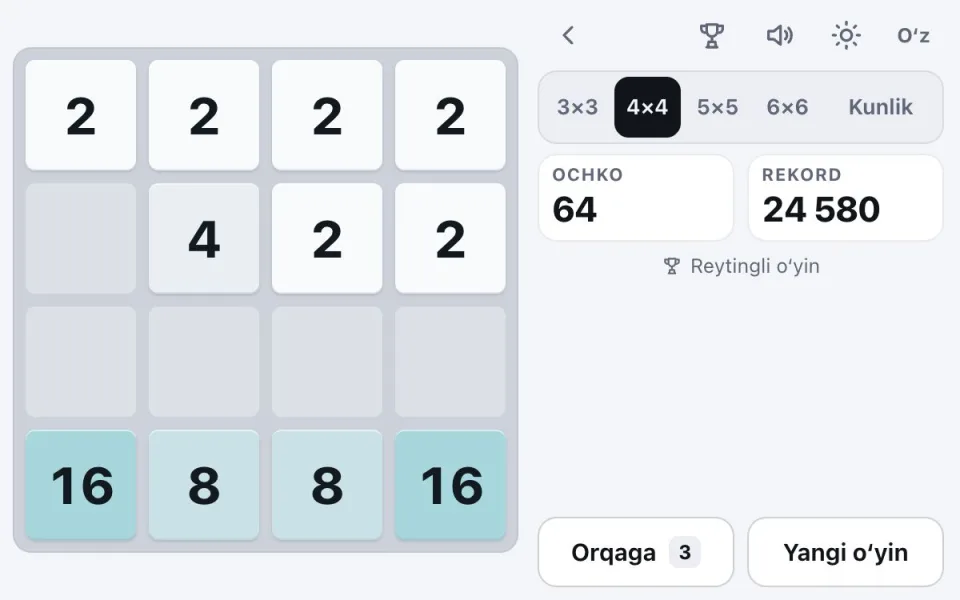 2048 rulesmerging, score, game over
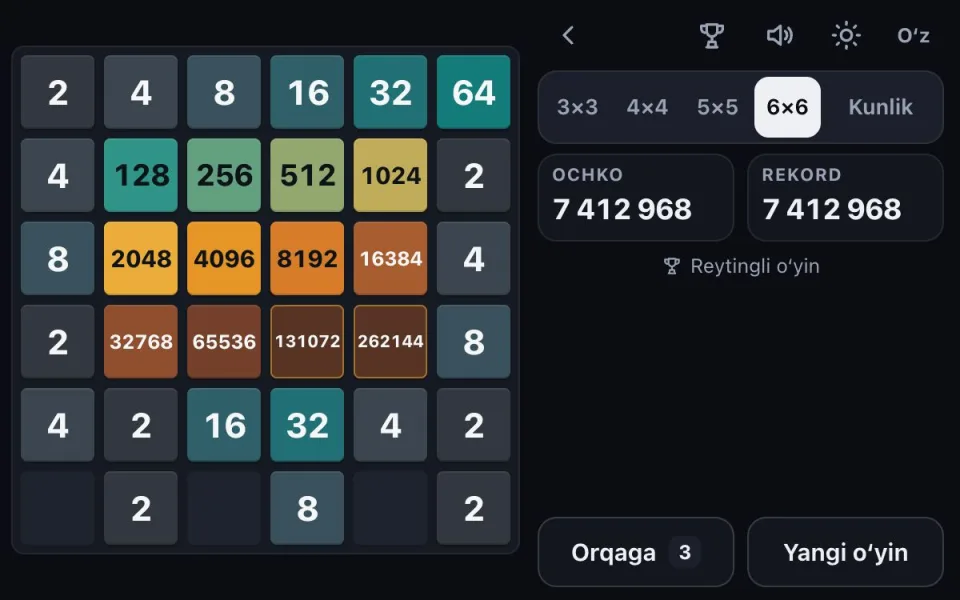 3×3, 5×5 and 6×6 boardshow hard each board really is
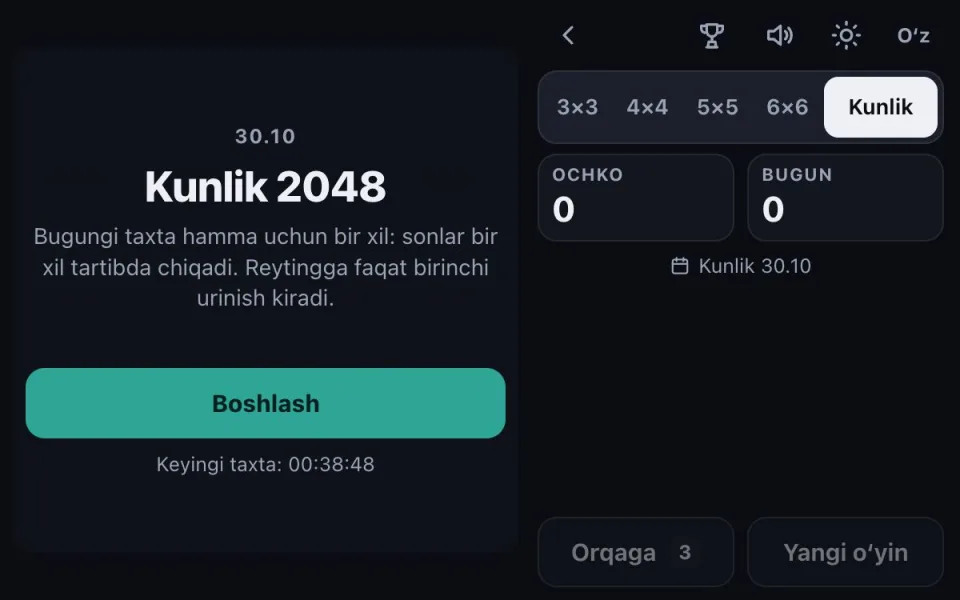 Daily 2048one board, the same for everyone
 2048 onlinefree, no sign-up