Techniques and levels
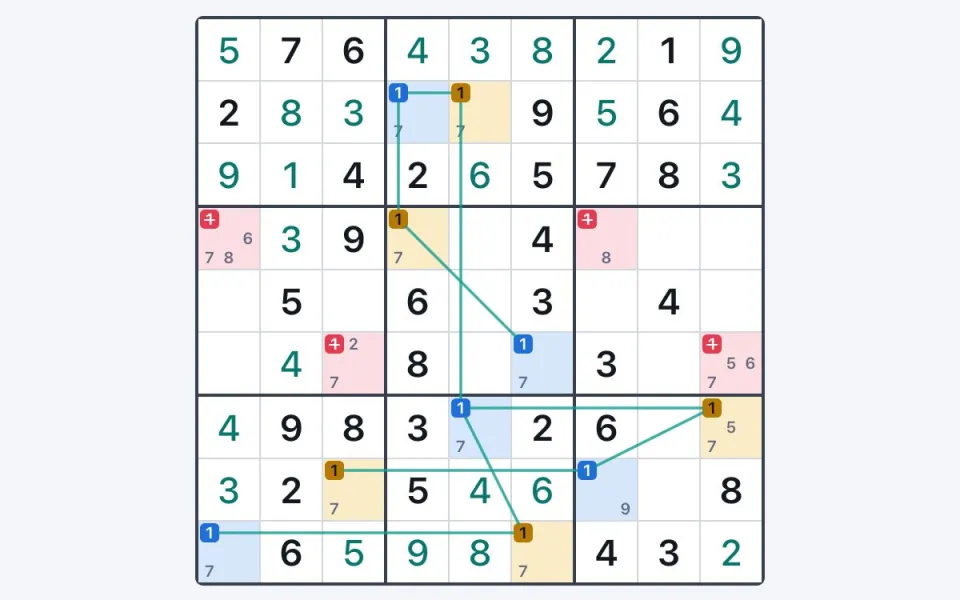
In the pictures: a green frame is the cell for the digit; a teal mark is a key candidate; a red mark is a candidate to remove; blue and yellow are the two sides of a chain or coloring.
| Technique | Needed on | Idea |
|---|---|---|
| Hidden single, Naked single | Easy and up | one place for a digit or one digit for a cell |
| Locked candidates | Medium and up | a digit stuck where a box meets a line |
| Pairs, triples, quads | Medium, Hard | n cells take n digits |
| X-Wing, Swordfish | Expert | one digit in a grid of rows and columns |
| XY-Wing, XYZ-Wing | Expert | whatever the pivot is, one wing gets the same digit |
| Coloring, chains | Master | a chain of “if not this, then that” |
Naked single
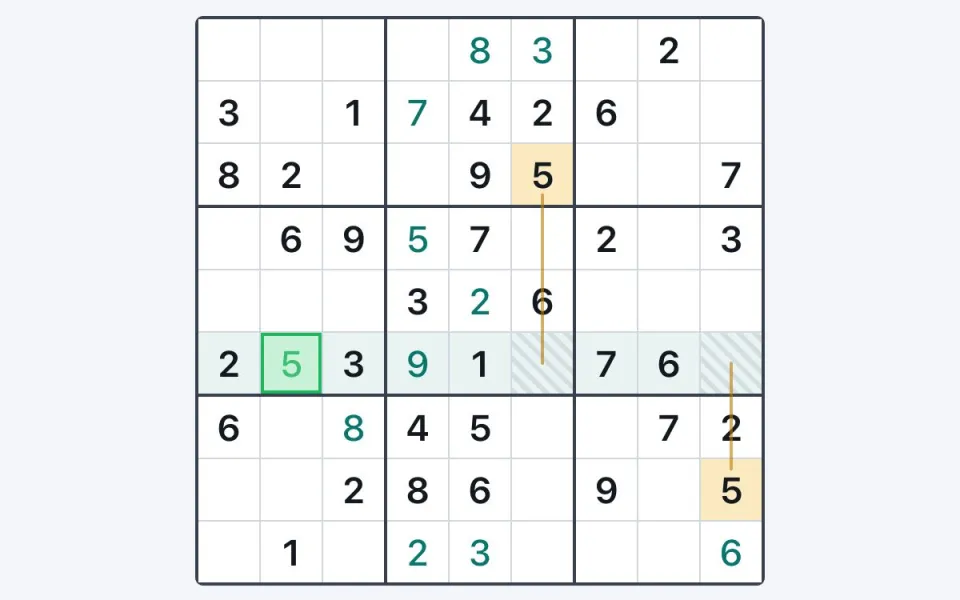
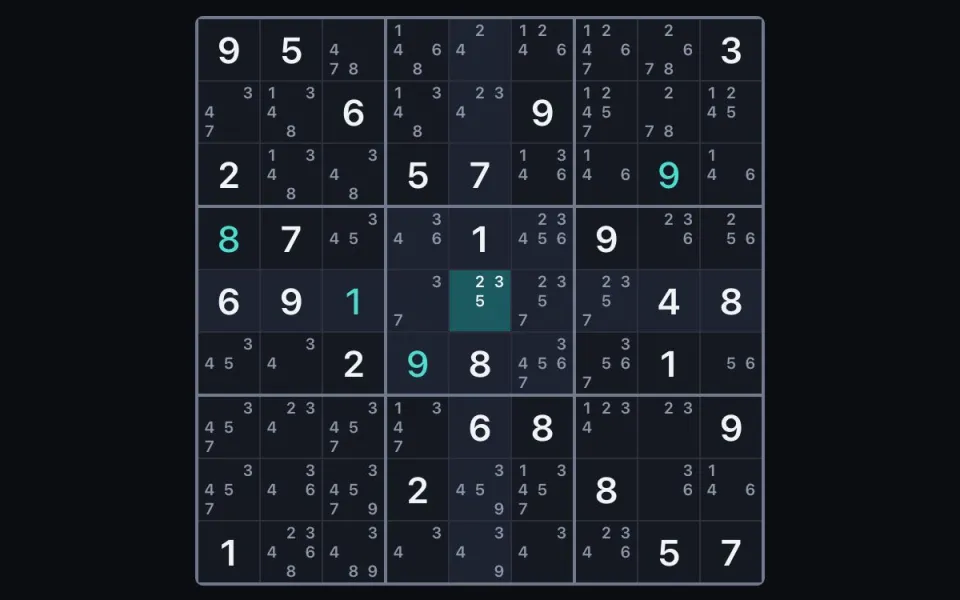
The reverse question: which digits fit this cell? Strike out those in its row, column and box. If one is left, that is the answer. With notes on the board such a cell stands out at once: it holds a single digit.
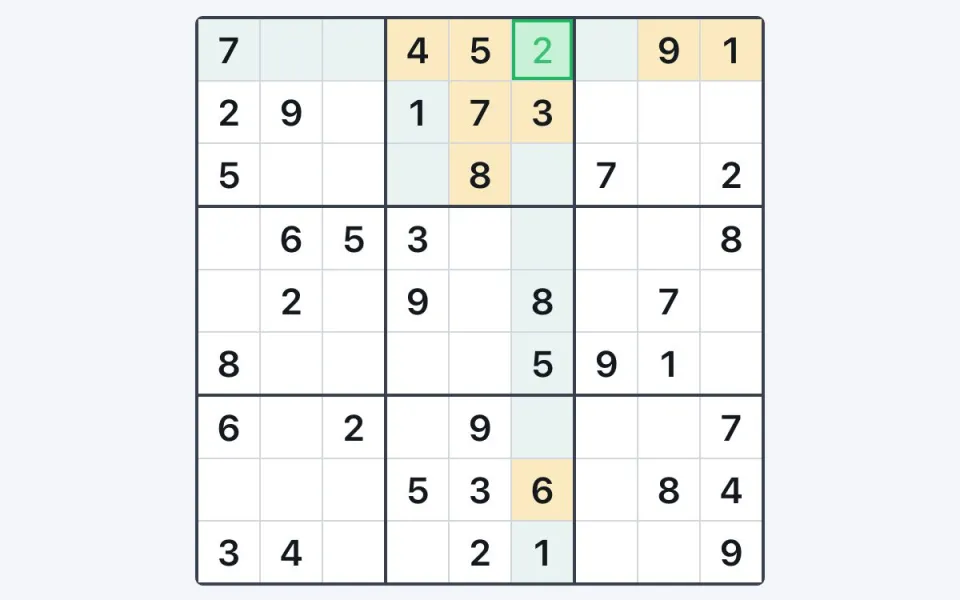
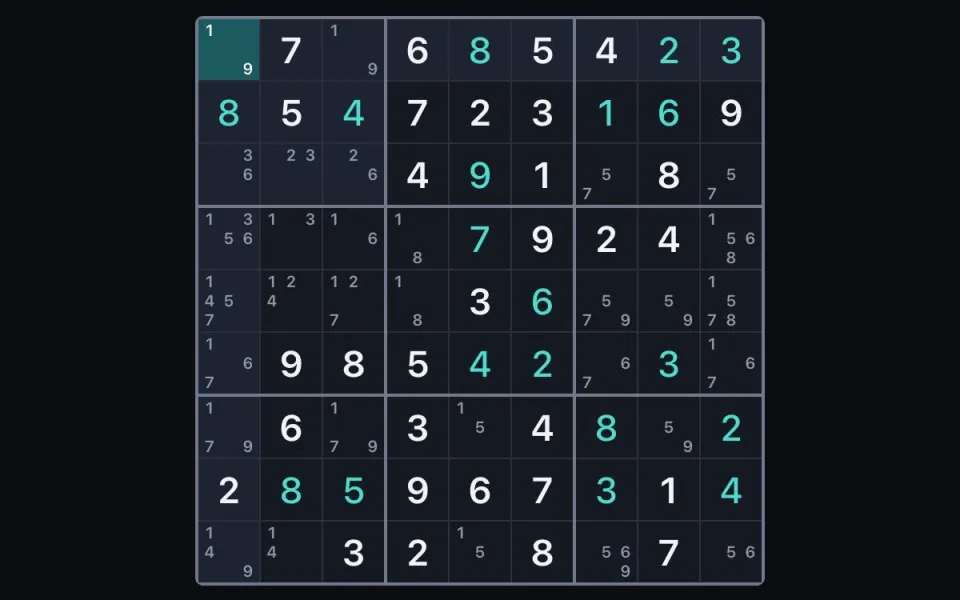
Example — Naked single. In the top-middle box, one cell can take only one digit. Look at row 1, column 6: its row, column and box already contain 1, 3, 4, 5, 6, 7, 8 and 9. Only 2 is left.
Locked candidates
Where a box meets a line (a row or column) there are three cells. If a digit in the box can only sit in those cells, it cannot go elsewhere on the line. The reverse also holds: if on the line it can only sit in those cells, it cannot go elsewhere in the box. No digit is placed, but the notes shrink and the next single opens up.
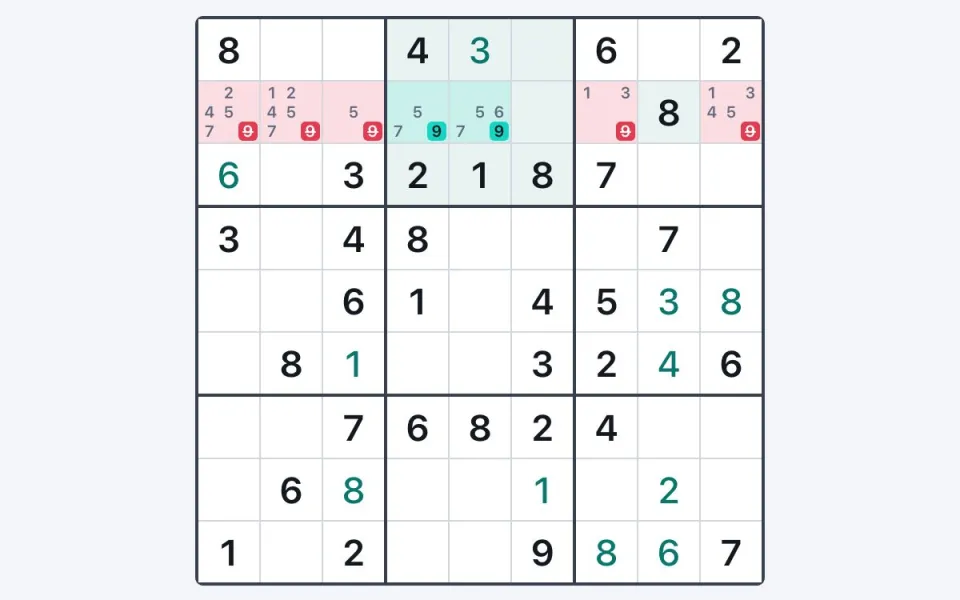
Example — Pointing pair. In the top-middle box, 9 can only go in row 2. The 9 of this box must sit in row 2. So the cells of row 2 outside the box cannot hold 9: remove the marked candidates.
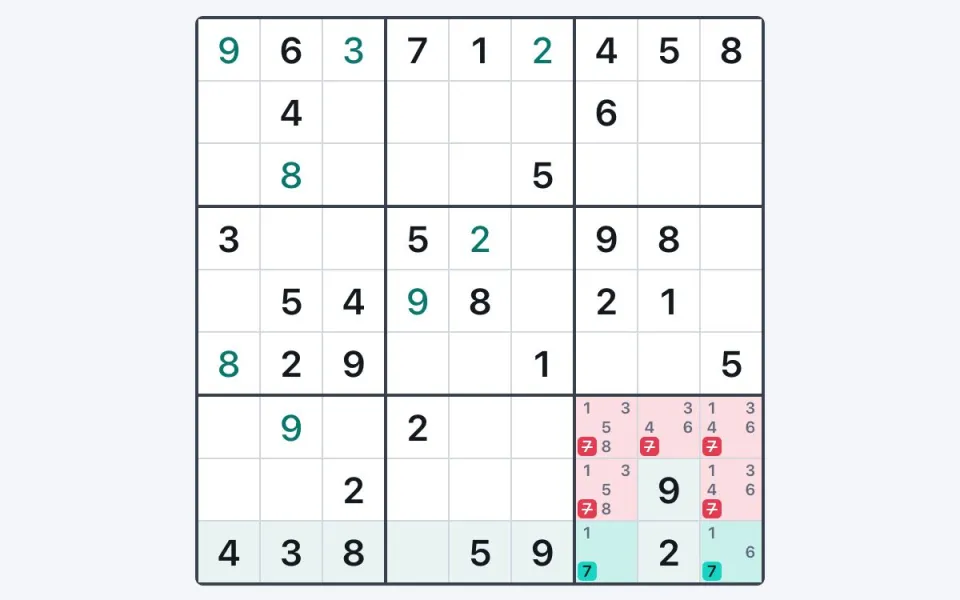
Example — Claiming candidate. In row 9, 7 can only go in the bottom-right box. The 7 of row 9 must sit in this box. So the other cells of the box cannot hold 7: remove the marked candidates.
Pairs, triples, quads
If two cells in a unit can only take the same two digits, those digits share these cells and cannot go elsewhere in the unit: that is a naked pair. In a hidden pair, two digits fit in only two cells, so the other candidates leave those cells. Triples and quads work the same way, just bigger.
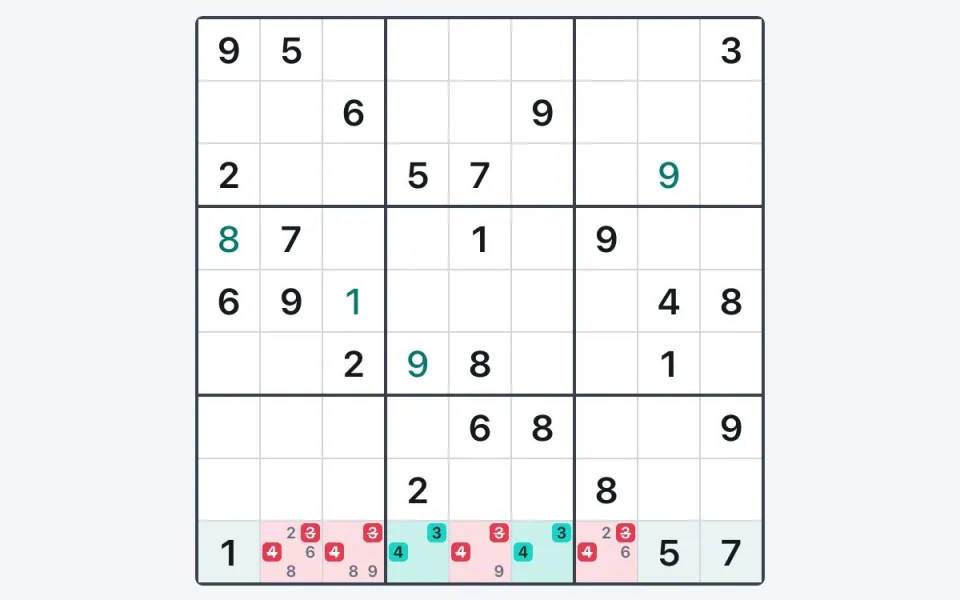
Example — Naked pair. In row 9, two cells can only take 3 and 4. These digits must fill exactly these cells, whichever goes where. So the other cells of row 9 cannot hold 3 and 4.
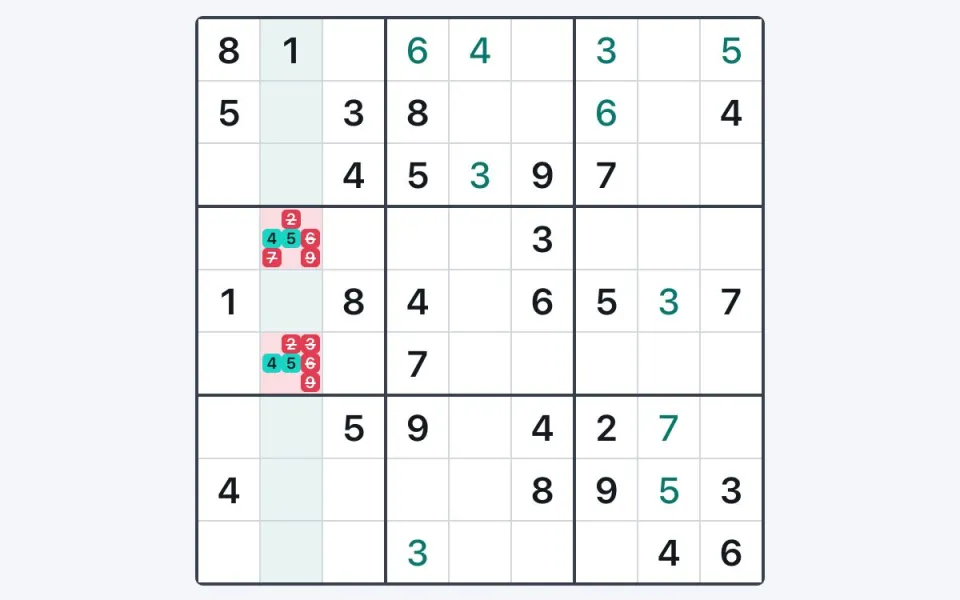
Example — Hidden pair. In column 2, 4 and 5 fit in only two cells. These digits have nowhere else to go, so these cells belong to them. Remove the other candidates from these cells.
X-Wing, Swordfish
Now look at one digit. Suppose that in two rows it fits in only two cells each, and those cells share the same two columns: they form a rectangle. The digit must take opposite corners. Whichever diagonal it is, both columns already have their digit there, so it can be removed from the rest of those columns. Swordfish is the same idea on three rows and three columns.
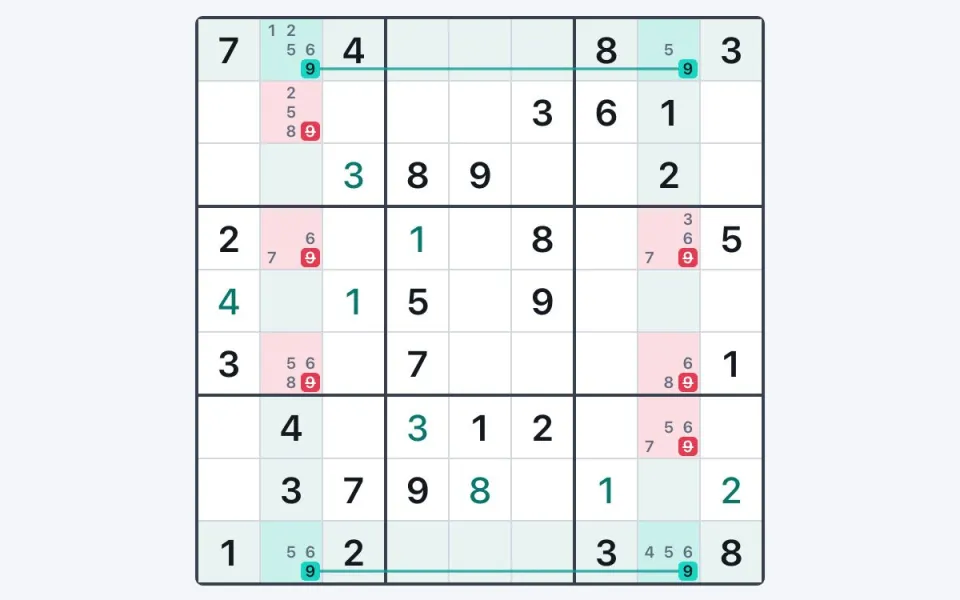
Example — X-Wing. In rows 1 and 9, 9 fits in only two cells each, and those cells share the same columns. 9 must sit on opposite corners of this rectangle. Whichever diagonal it is, columns 2 and 8 each get their 9 from these four cells. So no other cell in those columns can hold 9.
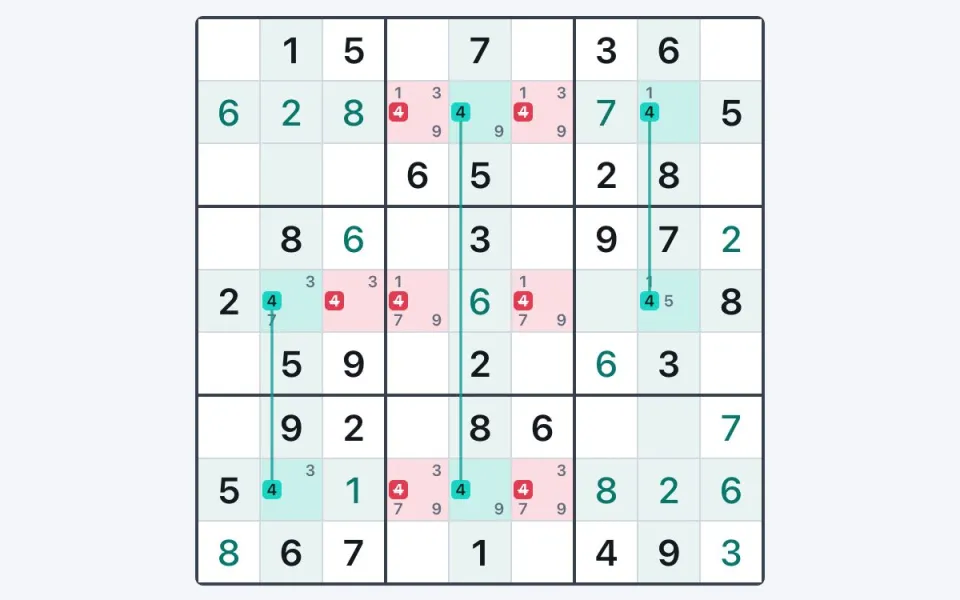
Example — Swordfish. In columns 2, 5 and 8, 4 can only go in rows 2, 5 and 8. The 4s of these three columns use up those three rows completely. So no other cell in those rows can hold 4.
XY-Wing, XYZ-Wing
Take three cells with two candidates each: the pivot sees both wings, and the wings share one digit. Whichever digit the pivot takes, one wing must end up with the shared digit. So a cell that sees both wings cannot hold it. In an XYZ-Wing the pivot has three candidates and may hold the shared digit itself, so it is removed only from cells that see all three.
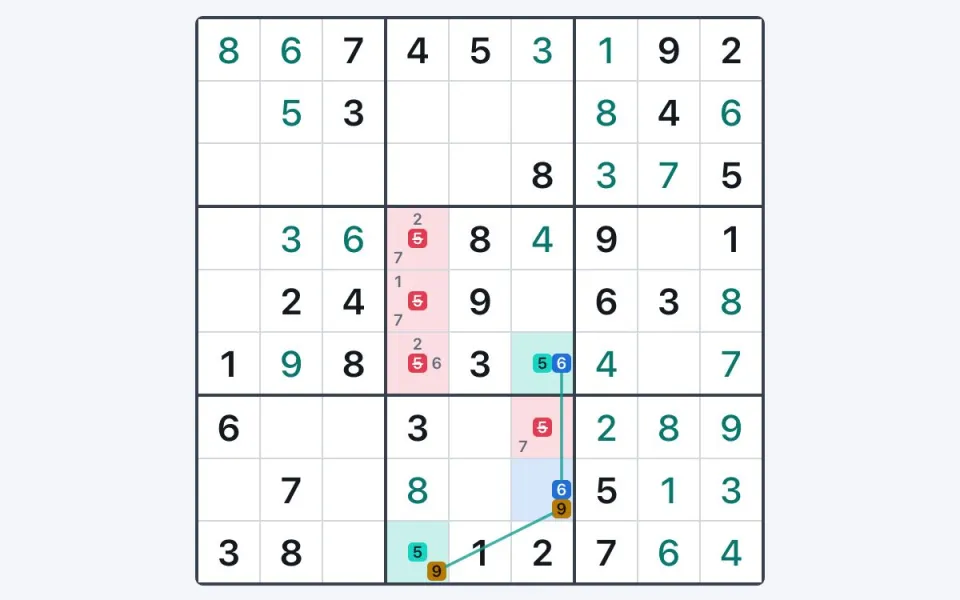
Example — XY-Wing. Three two-candidate cells are linked: the pivot has 6 and 9, the wings have 6 and 5, 9 and 5. If the pivot is 6, the first wing is 5; if the pivot is 9, the second wing is 5. Either way, one wing holds 5. So a cell in the same row, column or box as both wings cannot be 5.
Coloring and chains
If a digit fits in only two cells of a unit, they are linked: one is right, the other wrong. Join such links into a chain and split the cells into two colors: either all the blue ones are right or all the yellow ones. A cell that sees both colors cannot hold that digit. An X-Chain also follows one digit, while an XY-Chain runs through two-candidate cells and gives the same digit at both ends.
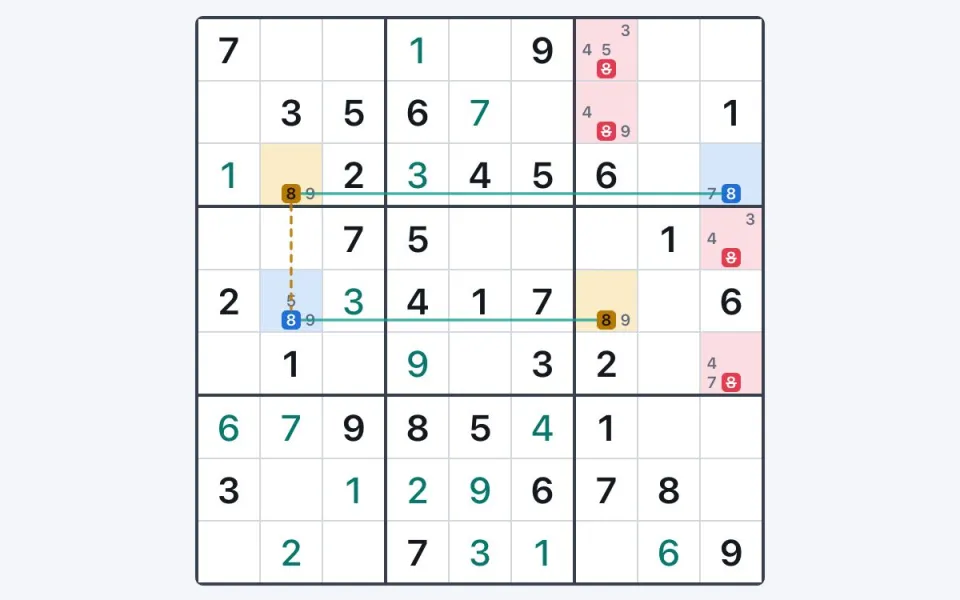
Example — X-Chain. There is a 4-cell chain for 8: one of its two ends must hold 8. In a pair on a solid line, 8 sits in one of the two cells; two cells on a dashed line cannot both hold 8. If the first cell is not 8, following the chain puts 8 in the last cell. So a cell in the same row, column or box as both ends cannot hold 8.
FAQ
Which technique should I learn first?
The hidden single. Every Easy puzzle can be solved with singles alone.
How do I find an X-Wing?
Pick one digit (tap its key and it lights up in the notes) and look for rows where it sits in exactly two cells. If two such rows have their cells in the same columns, you have found it.
Is guessing a technique?
Puzzles on this site never need a guess: all of them yield to the techniques above. And the hint never gives a digit without a reason.
 Hard sudokuHard, Expert, Master
 Sudoku rulesfor beginners
 Daily sudokuthree a day, with a leaderboard
 Sudoku onlinefree, no sign-up