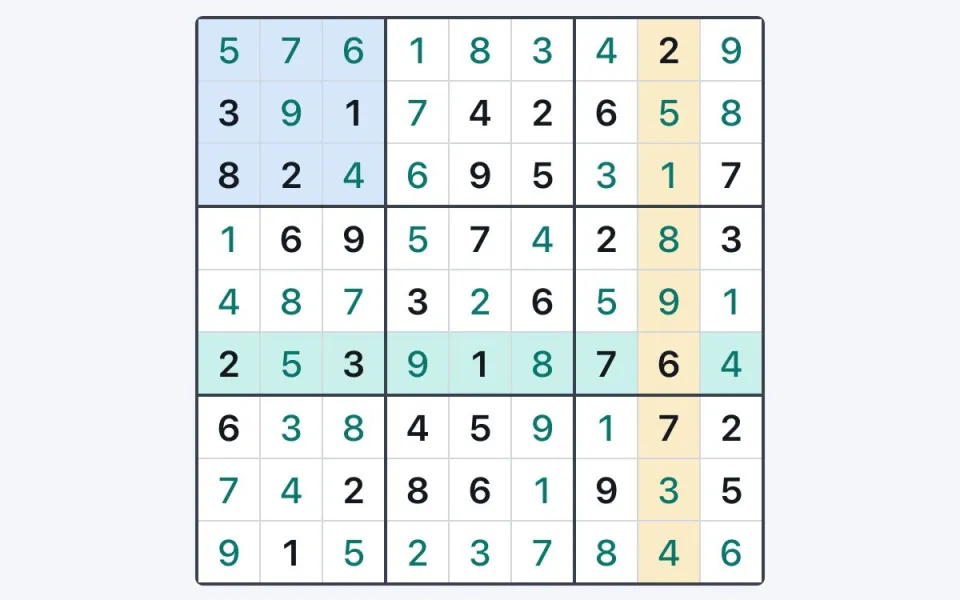
The one rule
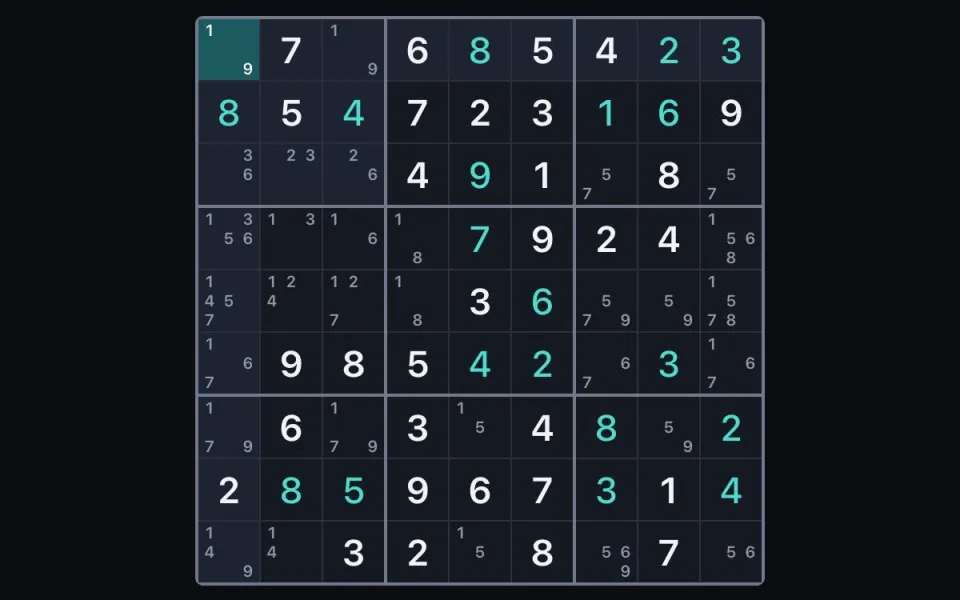
Every row, every column and every 3×3 box must contain each digit from 1 to 9 exactly once. The board has 81 cells: 9 rows, 9 columns, 9 boxes. Some digits are given and never change. Your job is to fill in the rest.
Basic terms
| Term | Meaning |
|---|---|
| Cell | a square that holds one digit |
| Row / column | 9 cells across / down |
| Box | a 3×3 square marked by thick lines |
| Candidate | a digit that could still go in this cell |
| Note | a candidate written small inside a cell |
A first step: an example
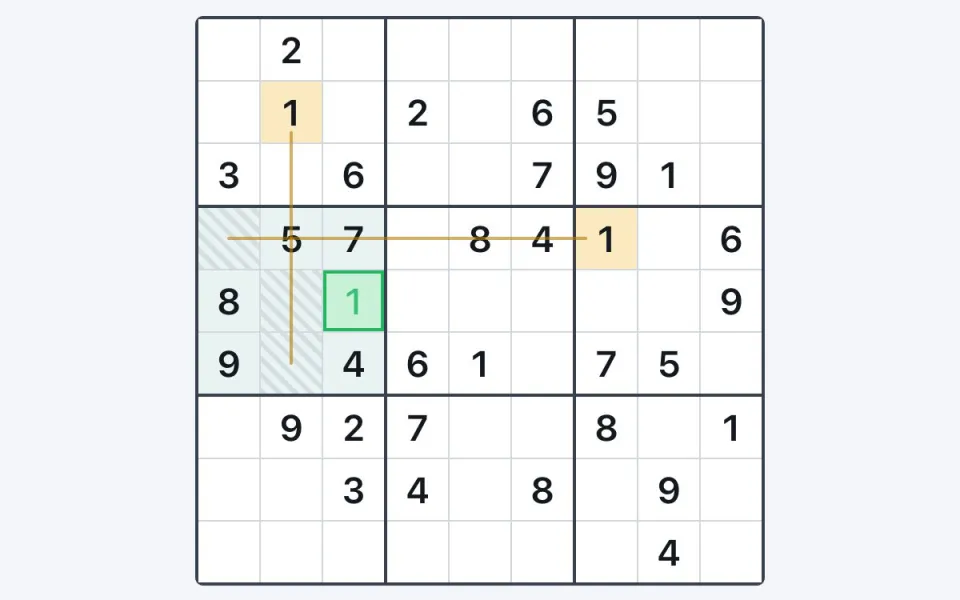
Start with one digit and look at one box. Which cells can it not go in? The same digit in nearby rows and columns rules cells out. Sometimes only one place is left:
Hidden single. In the middle-left box, 1 fits in only one cell. The other empty cells of the middle-left box cannot take 1: their row or column already has one. One place is left: row 5, column 3.
In the picture the yellow rays show the digits doing the blocking, hatching marks the closed cells and the green frame is the only place left. The in-game hint looks exactly like this.
Why notes matter
Easy puzzles can be solved without notes. From Medium up it gets hard to remember which digits fit a cell, so you write small candidates inside it. When you place a digit, the notes of its peers update themselves. Rather not write them by hand? The “Fill” button adds them all in one tap.
Common beginner mistakes
- Placing a digit on a hunch. Every puzzle yields to logic: if you are not sure, make a note.
- Looking only at rows. The easiest finds are often inside boxes.
- Getting stuck in one spot. Move to another digit: each new one can open up the earlier spot.
Once you know the rules, move on to the solving techniques.
FAQ
Do I need to be good at maths?
No. The digits could be letters or pictures and nothing would change: there is no arithmetic, only logic.
Can a puzzle have two solutions?
Not here: a program has proved that each puzzle has exactly one solution.
What if I place a wrong digit?
Depending on your setting the digit turns red and counts as a mistake. The game goes on: erase it and continue. You can also switch “Show mistakes” off.
How long does a game take?
On Easy, 10 to 20 minutes for a beginner and 3 to 5 for an experienced player. Master can take up to an hour.
 Sudoku techniquessingles to X-Wing, with examples
 Sudoku onlinefree, no sign-up
 Daily sudokuthree a day, with a leaderboard
 Hard sudokuHard, Expert, Master